Blog | May 5, 2026
Reducing costs, increasing efficiency
Cost optimization in intralogistics for future-ready supply chains
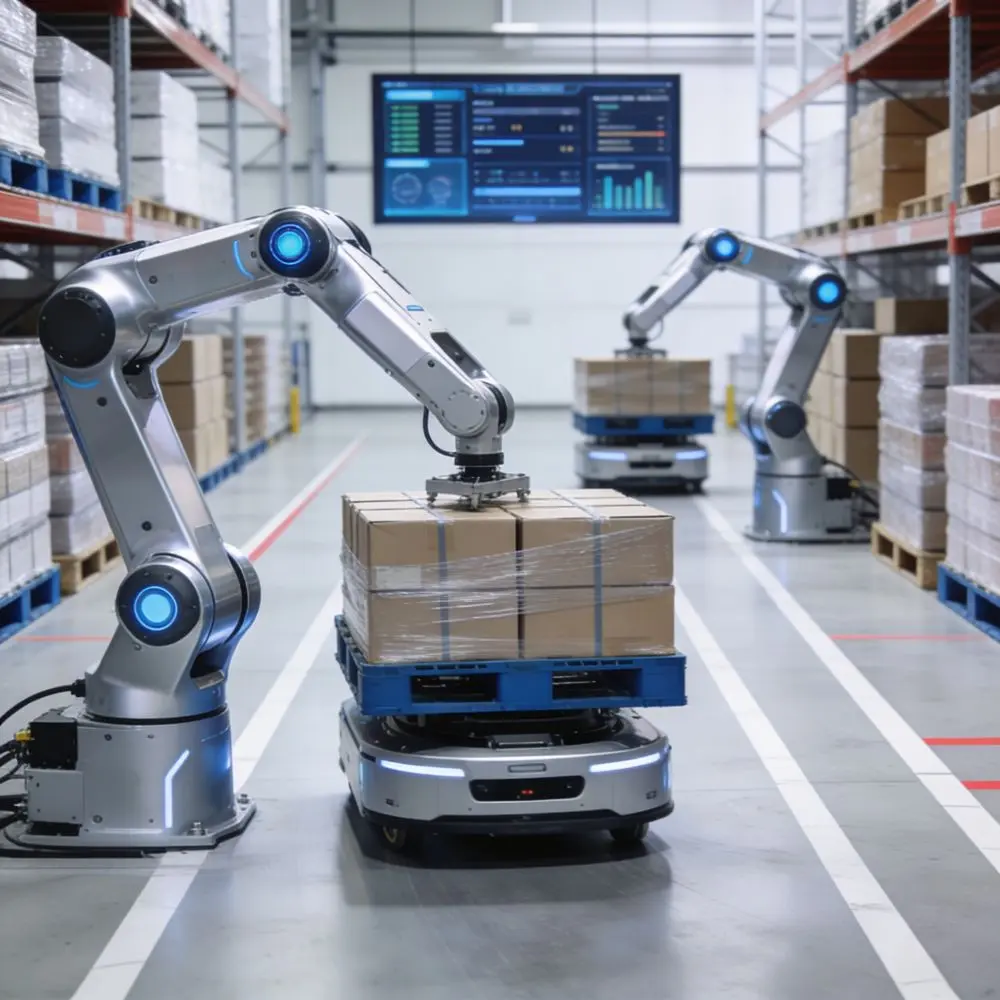
Organizations that optimize their intralogistics and production processes can unlock efficiency gains of up to 30%. By streamlining intralogistics operations, companies can reduce costs, future‑proof their facilities and build a competitive advantage. But achieving this level of optimization requires an integrated approach to analyzing and aligning processes, structures and data.
An integrated approach to efficiency – four key pillars
Efficiency in intralogistics cannot be viewed in isolation. To make meaningful improvements, each efficiency pillar must be understood in the context of the organizational level it belongs to. The four key dimensions are cost, space, throughput time and material flow.
-

Cost efficiency
How do your operational costs compare to industry benchmarks?
-

Space efficiency
How effectively are you utilizing your available space?
-
Throughput time efficiency
How quickly can you move products through your system?
-

Material flow efficiency
How smoothly do materials move from one process to another?
All four pillars work together. For example: Thanks to consolidation and organization efforts, a facility was able to reduce its space requirements by 20% while increasing output per square meter by 25%. The result was a significantly more productive use of space, driving measurable improvements across all efficiency dimensions.
Beyond cost and space efficiency, organizations should focus on order and material throughput times, as well as the utilization of personnel and technology. This integrated approach leads to higher performance, improved service levels, reduced inventory and ultimately lower overall costs. Firsthand experience shows that companies that address all four efficiency pillars together achieve 20-30% higher cost savings than those that optimize selectively.
The following steps are part of a proven approach that organizations can follow to comprehensively identify and realize optimization potential:
Identifying cost optimization potential
1. Create transparency
Optimization starts with full visibility into existing logistics processes and their associated costs. A detailed analysis of layouts, material flow technologies and IT infrastructure creates the necessary transparency to identify cost drivers and inefficiencies with precision. Processes are observed directly on the shop floor and visualized using tools like process-flow diagrams and value‑stream analyses. This transparency provides a solid foundation for fact‑based discussions with both management and operational teams about opportunities for improvement.

2. Assess maturity level and define targets
To quantify improvement potential and establish clear targets, current performance is benchmarked against best‑practice standards. A cleansheet calculation is particularly effective here, as it determines process costs under ideal conditions. Comparing current costs with optimized target scenarios highlights remaining performance gaps and quantifies the achievable cost optimization potential.

3. Prioritize and define measures
Next, concrete optimization measures are developed in close alignment with on‑site teams. Priorities are set collectively, taking into consideration not only expected savings and performance impact but also implementation complexity, investment requirements and operational risk. This ensures that initiatives deliver impact while remaining feasible.

4. Translate measures into a roadmap
The prioritized measures are then translated into a clear and actionable implementation roadmap with defined milestones. Resource requirements – for both day‑to‑day operations and the implementation phase – are calculated, and technical requirements are specified in detail. Early involvement of equipment and technology vendors helps shorten procurement cycles and accelerate execution.

5. Implement and anchor changes
Implementation in sprints has proven effective in classic process optimization projects. Incremental change facilitates successful change management across the organization, while pilot testing helps refine individual measures before rollout. Optimization initiatives will be most effective when the entire organization supports them. Therefore, structured change management is essential to drive long-term impact.

Leveraging data to your advantage
Detailed and reliable information is essential for generating meaningful audit results. Intralogistics IT systems – such as ERP and warehouse management systems, material flow computers, AGV control systems and sensor or IoT solutions – continuously produce the exact type of data that serves as a strong foundation for advanced, data‑driven process optimization. This includes process mining for diagnostic analysis or BI applications that provide real‑time KPI visibility. Additional examples include AI and machine‑learning models for forecasting and optimization, as well as digital‑twin simulations for evaluating alternative scenarios.
With this kind of advanced, data-driven process optimization, current state analyses can be completed up to 50% faster compared to conventional methods. Furthermore, micro-inefficiencies are frequently identified that would go undetected in traditional audits. Consider the following example: Using a data-driven approach, a tier‑1 automotive supplier achieved full transparency into its process costs and intralogistics performance, increasing efficiency by more than 20% while simultaneously reducing costs by one‑fifth.
Putting practice to work
A proactive mindset is essential for unlocking the full potential of intralogistics optimization. Rather than waiting for crises or bottlenecks to emerge, companies should leverage their data strategically and regularly challenge existing structures. A comprehensive approach that integrates all four efficiency pillars – combined with a clear, actionable roadmap – is a powerful lever for a future-ready supply chain.
This article is based on the German-language article “Von der Analyse bis zur Umsetzung: Wie Kostenoptimierung in der Intralogistik zukunftsfähige Supply Chains schafft“ originally published on logistra.de.
Download our e-book on cost-optimization in intralogistics here