
- Insights & events
- Blog

Blog | April 2, 2026
Orchestration at the speed of life
What a command center brings to your life sciences supply chain
Much critical decision-making in pharmaceutical supply chains still follows old rhythms: morning stand-ups, weekly reviews, monthly cycles. But today’s pharma supply chains move far faster than meeting cadences. Shipments get delayed at 3 a.m. Demand spikes can happen mid-afternoon. Batch release constraints and temperature excursions surface without warning. By the time teams meet, the window to prevent disruption and protect patients has already passed.
In recent years, leading pharmaceutical companies have tried to get out ahead of disruptions by establishing functional control towers for logistics, materials and manufacturing. These perform effectively but largely in isolation. Even though vital activities such as transportation management and order fulfillment are centralized, the way these functions interact remains constrained by legacy organizational boundaries. The result is visibility within functions, not true end-to-end integration across the network.
Supply chains operate in real time, but many organizations still react in intervals and silos. A command center closes gaps up and down the supply chain. Command centers link formerly independent control towers to turn siloed visibility into unified, real-time decision-making. The result is continuous sense‑and‑respond, enabling teams to act at the speed at which supply chains actually run.
What is a command center?
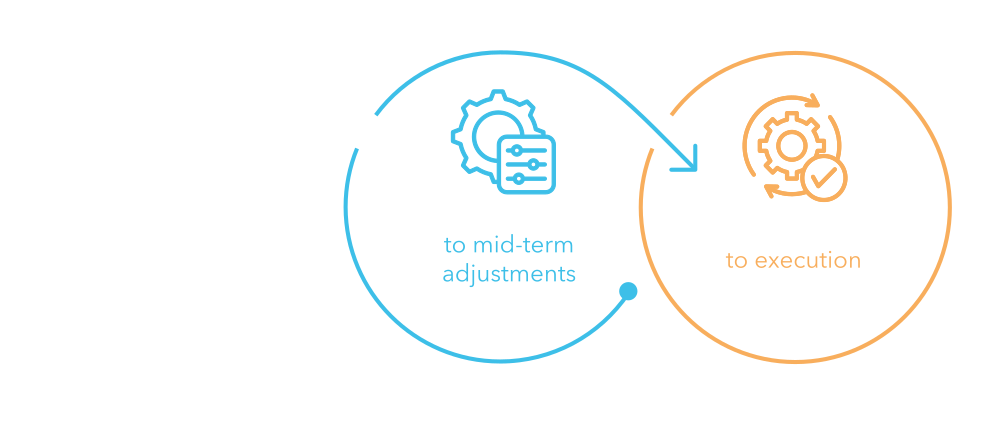
A command center is a centralized digital control hub supported by dedicated supply chain experts who work together to orchestrate operations in real time. It connects S&OP, S&OE, quality control (QC), quality assurance (QA), customer service, logistics execution and manufacturing, bringing together long-term planning, mid-term adjustments and day-to-day execution into one proactive, compliant, data-driven process.
Next-generation, AI-native systems improve this setup by enabling automated or guided decisions, allowing teams to anticipate disruptions earlier, respond faster and execute more smoothly at lower cost. Each action feeds back into the system, creating a learning loop that goes beyond the visibility-only approach of traditional control towers.
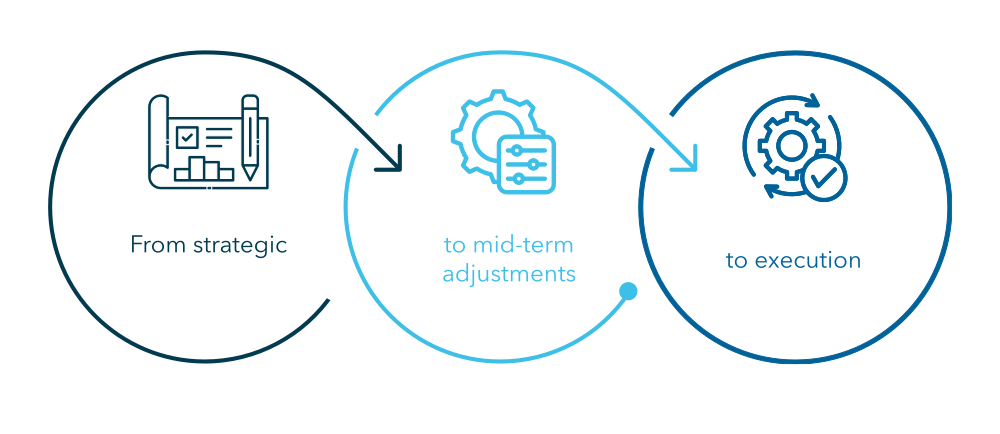
How a command center handles disruptions
A command center makes use of a consistent workflow built around three core functions:

Detection
The command center continuously monitors signals from logistics, planning and production systems to surface the issues that matter most: late shipments, quality holds, API/DP supply risks, changing demand or GDP-relevant temperature excursions, each with direct implications for service levels, compliance and, ultimately, patient trust.

Decision
Once a disruption is identified, the command center becomes the collaborative hub where stakeholders review the scenario, compare options using simulation and quickly align on the best path forward in terms of cost, service, regulatory compliance and patient impact.


Deliver
Approved actions flow directly into execution systems, enabling rapid follow-through – whether it’s rerouting a shipment, triggering a replenishment, adjusting production or communicating with a customer. Routine steps can be automated, while experts focus on decisions that affect patients and revenue. Execution outcomes are captured and fed back into planning, refining parameters and strengthening future responses through a closed-loop feedback cycle.
What a command center can be used for
-


Coordinating complex inbound networks
A command center can orchestrate flows across hundreds of suppliers and global manufacturing sites. By unifying transportation, ordering, inventory and warehouse data, it prevents disruptions before they hit production. Teams benefit from a shared place to:
Consolidate shipments and reduce transportation costs
Align priorities and streamline order management
Optimize inventory and warehouse performance in real time
-


More agile and responsive planning
A command center closes the execution gap by ensuring plans remain synchronized with real‑time constraints in manufacturing, logistics and quality. When demand shifts quickly, long planning cycles and manual processes create delays, bottlenecks and late reactions.
A command center enables teams to:
Detect short-term deviations in demand, supply or logistics capacity
Understand the revenue and service impact of each disruption
Reprioritize and adjust plans faster, based on real constraints
Move from slow, cyclical planning to continuous, exception-driven steering
-

Reducing stockouts and improving OTIF
A command center helps companies prevent stockouts by continuously sensing availability issues across the entire network and guiding the best alternative fulfillment option. Instead of reacting only when a stockout occurs at the warehouse, teams can:
Evaluate mitigation options like stock transfers, direct sourcing or rerouting
Prioritize customers based on impact, profitability, service-level risk or product perishability
Automate routine exception handling and reduce late or incomplete deliveries
Command center in action: step-by-step service failure prevention
1. Detect the risk before anyone feels the impact
The system continuously monitors production and supply signals across the pharmaceutical manufacturing network and flags a risk: Based on historical performance patterns, batch 4711 has a 35% probability of being released four days late.
This is not yet a problem, but an early warning creates conditions for proactive decision-making instead of reactive firefighting.

2. Connect the dots across the chain
By linking production with downstream demand, it becomes clear that this delay is not isolated:
Batch 4711 is required to fulfill material XYZ
Material XYZ is already allocated to a time‑critical customer order for a health-care distributor
A late batch = a late order + a warehouse shortage

3. Understand the impact – what happens if we do nothing?
The command center quantifies the real business consequences:
The customer order is delayed by four days
OTIF performance drops from 95% to 85%
The French market faces a two-day stockout
Estimated lost sales of 100k €

4. Select the best mitigation option
The command center evaluates alternatives and recommends action:
Advance the availability of batch 4711 by reprioritizing QC workload based on risk and required coverage
Expedite release of an alternative batch with available capacity downstream
This introduces an additional cost of 5000 € but avoids the much larger commercial and service impact while preventing disruption to patient supply.

5. Turn decisions into actions
The decision is executed immediately:
Batch is released earlier than planned following QC/QA release
The order is delivered on time and in full

Results:
-

No stockout occurs in the market
-

OTIF remains stable at 95%
-


Lost sales are fully avoided
Moving toward supply chain orchestration
By adopting a command center, pharmaceutical organizations improve visibility, responsiveness and control and move closer to a fully orchestrated supply chain. Inventory can be right-sized thanks to earlier risk detection and better alignment with actual demand. Transportation costs decrease thanks to fewer premium shipments, stronger predictability and reduced avoidable charges. Service performance improves because teams act consistently, collaboratively and faster than before. Patient and customer trust increases thanks to consistent supply performance.
For pharma companies looking to move beyond control towers, a command center becomes the foundation for turning data into decisive action, enabling real-time decision-making, faster execution and stronger operational resilience in a landscape defined by regulatory scrutiny, volatile supply and growing patient expectations.
If you could cut your decision latency from days to minutes, what would your supply chain look like 12 months from now?
At 4flow, we partner with pharma leaders to build resilient, digitally orchestrated supply chains designed to anticipate and proactively manage change.
Authors

Daniela Santos
Sales and Strategy Life Sciences
4flow

Jens Buschfeld
Vice President
4flow