Blog | May 13, 2026
Control towers and command centers
Finding the solution that meets your supply chain needs
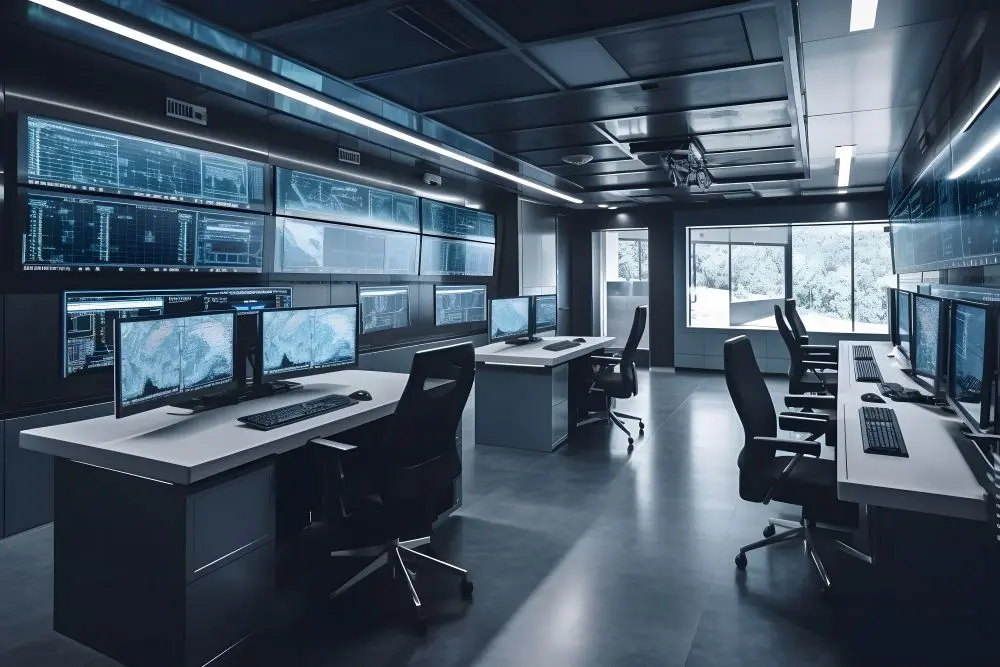
Control towers and command centers are often mentioned as if they were the same thing. In reality, they address different supply chain challenges. Both solutions combine personnel and technology to help companies achieve a more orchestrated supply chain. But whereas control towers strengthen execution within a defined area, command centers align decisions from end to end. Understanding the uses and benefits of each helps organizations choose the operating model that best fits their needs.
The control tower: structured visibility and specific optimization
A control tower is a customized logistics solution that combines dedicated teams, defined processes and supporting software to monitor and manage execution in a specific area of the supply chain. A control tower might oversee inbound and outbound transportation, or customer service, or regional operations.
What defines a control tower is not the technology behind it but the scope.
Typical characteristics of a control tower include:
-

A clearly defined functional or regional domain
-
Centralized monitoring of execution and performance
-

Real‑time detection of deviations and exceptions
-

Standardized responses and escalation within predefined operational boundaries
A common example is a transportation control tower. Here, teams centrally monitor shipment execution across carriers, modes and regions. They track whether transportation is running as planned, detect delays or capacity issues in real time, and intervene when deviations occur, for instance by rebooking shipments or coordinating with carriers and warehouses. Decisions are made quickly and consistently, but always within the area of the supply chain that the control tower is responsible for.
The command center: an end‑to‑end decision layer
A command center addresses a different challenge: As supply chains become more interconnected, problems rarely stay within one function or region. Actions taken to optimize performance in one part of the supply chain can influence outcomes elsewhere, sometimes with unintended side effects. What improves transportation reliability may constrain production flexibility. What stabilizes inventory locally may shift risk downstream.
To resolve this, a command center connects planning horizons and execution functions to enable coordinated decisions across the supply chain. A command center does not take over operational processes but rather unifies them in one end-to-end decision layer.
Key characteristics of a command center include:
-
End-to-end scope across planning, execution and exception management
-

Centralized decision authority, not just centralized visibility
-

Structured decision workflows that replace ad hoc escalations
-

Impact-based evaluation of trade-offs across cost, service, inventory and revenue
-

Scenario-based decision support, such as simulating alternative responses before actions are taken
Rather than focusing on a single domain, a command center is responsible for whole networks, identifying disruptions, evaluating their business impact and orchestrating the most appropriate response across the entire supply chain.
From control tower to command center
Control towers and command centers each offer distinct – and sometimes even complementary – benefits.
Companies that opt for a control tower will rarely rely on a single, self-contained execution setup. Some operate multiple control towers, each supporting a specific function, region or execution area. Others run a single control tower alongside separate planning, manufacturing, inventory or customer service organizations. In both cases, control towers reduce manual coordination, improve execution discipline and increase responsiveness within their domains, making them a necessary first step for organizations struggling with fragmented operations or limited transparency.
Yet in complex global supply chains, decision-making spans across more and more boundaries. Transportation control towers might be effective at detecting delays based on time thresholds or escalation rules, for example, but without visibility into what is being transported and how it affects downstream operations, prioritization remains local. A two‑day delay on a non‑critical shipment may trigger significant attention, while a two‑hour delay on a critical component can cause a production stop or stockout.
For organizations that operate these kinds of supply chains and face mounting volatility, the command center represents the next maturity step. With a control tower, control towers remain critical. They provide excellence in execution and domain expertise. What changes is not where execution happens but how decisions are made: Instead of being resolved in isolation, priorities and actions are coordinated through a single end‑to‑end decision logic that accounts for trade-offs across the entire supply chain.
Choosing the right model for your supply chain
A control tower is often the right starting point when execution is fragmented and teams struggle with basic transparency and consistency. Typical signals include:
- Limited real‑time visibility
- High manual coordination effort
- low reaction to operational deviations.
In these situations, a control tower helps stabilize execution, standardize processes and improve performance – within its defined area.
A command center becomes critical when operational decisions span multiple functions or planning horizons and disruptions trigger repeated escalations or KPI trade-offs that cannot be resolved locally. Typical signals include:
- Frequent escalations and meetings to align on the same issue
- Conflicting decisions across functions
- Teams optimizing their own KPIs while service, inventory or cost performance deteriorates elsewhere
Contact us and learn more about which model fits your supply chain
Is your organization mainly coordinating execution within individual domains? Or are you actively prioritizing decisions across the end-to-end supply chain?