
- Insights & events
- Blog

Blog | October 07, 2026
Make faster, better supply chain decisions with AI decision intelligence
How supply chain leaders can move from AI pilots to real impact
Top leadership expects AI to deliver results: cost reduction, greater efficiency, improved resilience. Pilots deliver some promising results, but for 89% of supply chains, the technology has yet to deliver the expected impact.
In many cases, that’s because teams are bolting AI onto existing processes or treating it as an advanced form of automation. The teams that use it as intelligent support for the tasks humans struggle with – like making confident, data-driven decisions – are starting to see value.
What is decision intelligence?
Decision intelligence refers to the use of AI and connected data to enable better decisions. In supply chains, AI can improve decisions across network design, logistics, risk and disruption management and more.
Why AI-driven decision-making delivers value at scale
Strategic supply chain decisions depend on data that’s spread across multiple systems, teams and geographies. And to be effective, these decisions usually have to be fast. In most supply chains, there’s no way to get the full picture quickly enough.
Slow decisions have financial consequences. For example, a delayed reaction to a supplier failure or capacity crunch can cascade into production stops, late deliveries or emergency freight costs.
This opens an opportunity for AI to create measurable value by compressing the time between signal and decision. Where humans struggle, AI can step in: agents can continuously monitor conditions across systems, surface relevant exceptions and simulate response options faster than any analyst working across disconnected data sources. AI platforms can even use all this data to recommend a course of action, while the actual decision stays in human hands.
Cross-functional connectivity is the differentiator
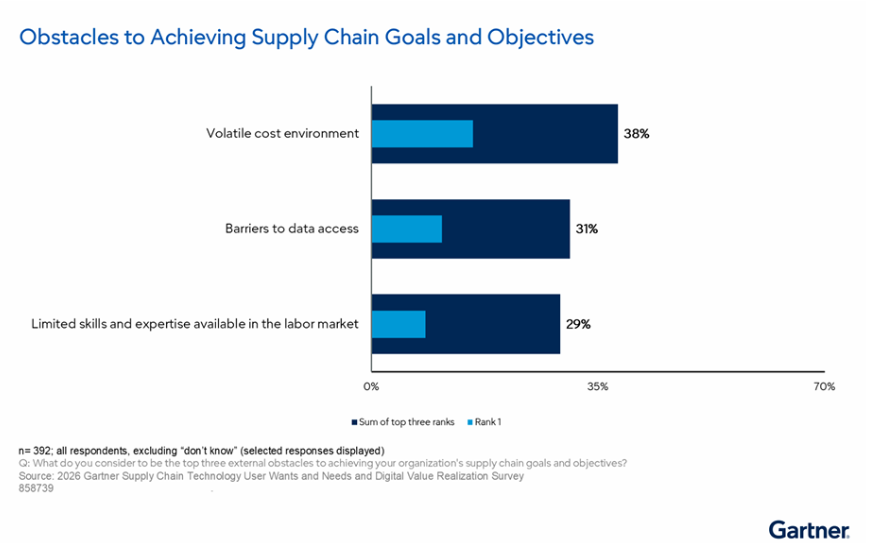
Most large organizations run ERPs, transportation management systems, warehouse management systems and planning tools in parallel, with limited cross-system visibility. Gartner® reports that over 30% of supply chain leaders name barriers to data access as a main obstacle in their work.* No single system gives an analyst or the data insights needed to make a fast, confident decision about, for instance, a supplier disruption affecting multiple customers across all regions and a recommendation on how to reprioritize existing inventory on hand.
Better decisions. Faster execution. Lower costs.
Discover optaire by 4flow, the modular, AI-native platform for end-to-end supply chain and logistics optimization
Learn moreHow can leaders get around these data silos without a total system overhaul? AI-powered platforms connect existing systems. In the Coolest Vendor Innovations in Cross-Functional Supply Chain Technology (2026) report, Gartner analysts explain: “By connecting physical operations, enterprise systems and external signals above existing platforms, these solutions can improve speed, accuracy, resilience and productivity without requiring full platform replacement.”
This capability separates AI-native platforms from traditional supply chain software. Traditional systems record and report what happened. A connected, AI-native platform monitors and interprets what’s happening across multiple systems in real time and makes recommendations. As Gartner notes, “The value comes from helping organizations sense conditions earlier, simulate options faster and then decide and act with greater confidence.”
How to implement AI-driven decision intelligence in supply chains: 5 best practices
Cross-functional connectivity is the starting point for effective decision-making with AI. But implementation is about more than just system configuration. These five practices set successful deployments apart.
- Start where the operational pain is highest. Identify specific use cases where manual effort, data fragmentation and slow decisions are generating the most cost or service risk. Disruption response, carrier capacity management and inventory rebalancing are common high-value starting points. Prove value there before expanding.
- Establish governance before automating decisions. AI agents can recommend and, in some cases, execute actions across systems and partners. But without defined decision steps, exception protocols and escalation paths, automation creates new risks rather than reducing them. Treat governance as a prerequisite for AI value.
- Keep humans in the loop for consequential decisions. The goal of decision intelligence is giving decision makers better information faster, so they can act with confidence. For high-stakes decisions like network restructuring, major sourcing shifts or crisis response, human judgment remains essential.
- Treat change management as a technical requirement. New tools are providing an opportunity to coordinate actions based on one connected data set. Let your team recognize how AI can increase their productivity and save time by augmenting their decisions, rather than replacing their judgment. Organizations that try to skip that trust-building phase tend to struggle with adoption.
- Don’t wait for perfect data. Start accumulating data in your platform gradually, instead of trying to connect everything at once. Starting with a single high-value use case and iterating from there lets you demonstrate value while continuously building your supply chain data ontology.
Now is the time to start your AI transformation
The competitive cost of delaying digital transformation in the supply chain is rising. It’s estimated that fragmented data across tools leads to revenue losses of 6-10% during the disruption. Meanwhile, organizations that have moved beyond pilots and implemented use case are reducing time to decision and in turn, saving costs and improving service levels.
The path forward requires a clear starting point: identify the decisions that cost the most when made slowly or with incomplete information and put AI to work building up that connectivity. That is where decision intelligence starts.
Author

Natalia Andreyeva
Vice President at 4flow
Source: Gartner, Coolest Vendor Innovations in Cross-Functional Supply Chain Technology (2026), Caleb Thomson, Vas Plessas, Tess Frenzel, 24 July 2026.
GARTNER is a trademark of Gartner, Inc. and/or its affiliates.
*Gartner does not endorse any company, vendor, product or service depicted in its publications, and does not advise technology users to select only those vendors with the highest ratings or other designation. Gartner publications consist of the opinions of Gartner’s business and technology insights organization and should not be construed as statements of fact. Gartner disclaims all warranties, expressed or implied, with respect to this publication, including any warranties of merchantability or fitness for a particular purpose.
This graphic was published by Gartner, Inc. as part of a larger research document and should be evaluated in the context of the entire document. The Gartner document is available upon request from 4flow SE.