“Software is going to be the key to success, no matter how you look at it”
Damian, Vice President Go-To-Market New Tech Europe in Berlin, 4flow software
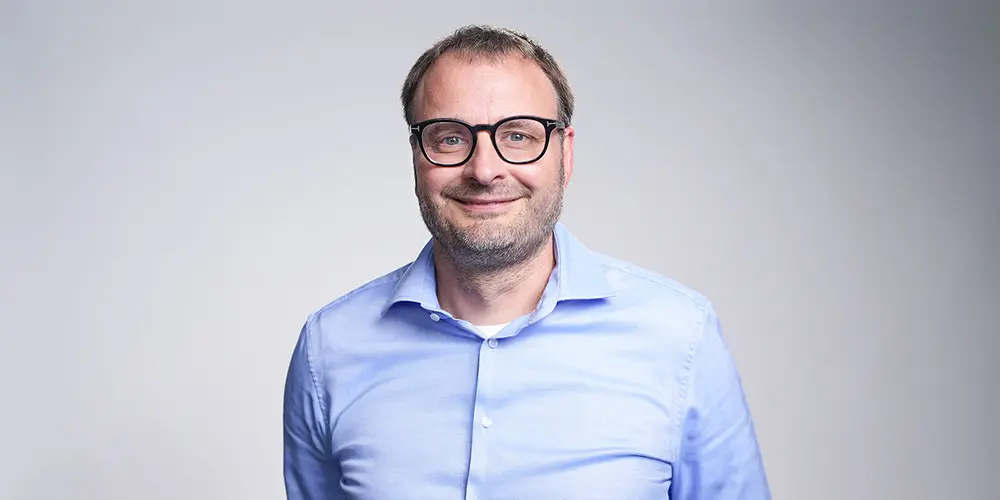
Damian Unterlöhner is vice president go-to-market new tech Europe. He first joined 4flow in 2008, left in 2021 and returned in 2025 to lead the European go-to-market strategy for optaire. In this interview, Damian shares what brought him back and why he believes AI will reshape supply chain.
How did you become interested in supply chain?
I came to be interested in supply chain, but technology has always fascinated me. As a kid I loved computers – taking them apart, putting them back together and installing MS DOS/Windows wherever I could. One memory really sticks with me: Around 1995 or 1996, I read a long article in Der Spiegel about FedEx. I found it fascinating how things move around the world and how successful that company was. Maybe that article helped put me on the supply chain path.
How did your journey with 4flow begin?
My journey at 4flow has not been a straight line. I started with 4flow consulting and later moved over to 4flow management. There I focused on scaling the management business and taking our first customers live. One of those early customers projects helped to lay the groundwork for what would grow into the 4flow iTMS software solution.
You left in 2021 and came back in 2025. What brought you back?
The opportunity to lead the go-to-market strategy for optaire in Europe was a very exciting challenge. Software is going to be the key to success, no matter how you look at it.
But coming back also felt like continuing something I had already started. When I left, there was an idea of where things could go but the steps hadn’t been taken yet. Once the business decision was made to focus on setting new standards for end-to-end supply chain optimization, I didn’t have to think twice about returning. The decision felt natural, and as I had remained in touch with 4flow community, there were no surprises when it happened.
As a software platform, what makes optaire different?
I’d highlight two things. First, optaire combines detect, decide and deliver in one tool. It’s not about simply spotting something wrong in a network; it’s about making sound decisions and executing them.
Second, optaire looks at supply chains from end to end. Traditionally, transportation issues are solved with solutions like adding a second driver or expediting a shipment. But optaire widens the solution space by also looking into the domain of materials. For example, instead of just speeding up a delivery, a better solution might be to ship 150 items now to cover until the next batch arrives. optaire allows us to question assumptions that once went unchallenged. We never used to question a request for 200 items to be delivered by December 12. Now we question the 200 items and we question December 12.
optaire breaks down the barriers between material management, production scheduling and transportation management and increases the possibility for better solutions.
What do you see as the biggest potential for AI in supply chain?
Supply chains that can be orchestrated autonomously. It’s still a vision, but I’m confident we’ll get there one day.
Most companies today sit somewhere earlier on the path. They experiment with automation and generative AI. Automation alone, though, has limits in supply chain. Why? Automation works best for linear workflows. But in supply chain, there's everything to the left and everything to the right and a lot of gray in between. The gray area is exactly where generative AI can help and this is the new playing field for optaire.
Let’s switch gears. What does your perfect Sunday look like?
I need to have something to do. Just sitting around usually isn’t an option for me. It doesn’t really matter what it is. Something in the garden, a task around the house or taking the kids to a dance performance or soccer game. It’s a perfect Sunday whenever I don’t have to think about the things I need to get done for Monday!
How do you like to spend your free time?
Honestly? I love sleeping. Beyond that, I love the mountains, whether in summer or winter, it doesn’t matter. A perfect vacation is a mix of time by the sea and a week or so in the mountains, preferably in Europe. I’m not a fan of long-distance flights.
Of course, family life keeps me busy. My oldest is 12, the middle one is 10 and our youngest is six months old.